Last updated October 15, 2026
ADU Permits, Codes & Inspections in CA: What You Need to Know
California law now prohibits cities from requiring owner-occupancy for ADU permits, but some Fresno homeowners are still being told otherwise at the planning counter. That single piece of misinformation causes more project delays, abandoned plans, and unnecessary legal fees than almost any other ADU issue we see. This guide and our The Complete Guide to ADU in Fresno explain the actual permitting hierarchy in California, what Fresno’s Development and Resource Management Department can and cannot legally enforce, how to avoid the re-submittal loop that eats months, and what inspections actually look like on the ground. By the time you finish reading, you’ll know exactly what to ask for, what to push back on, and what to budget before you file.
Quick Answer
ADU permits in California follow state law first and local ordinance second. In Fresno, a standard attached or detached ADU under 800 square feet can be reviewed in as little as 60 days once your application is actually complete, and ADUs under 750 square feet are exempt from impact fees by state law. The permit process typically costs between $3,500 and $9,000 in city and school fees, takes 2 to 6 months from filing to issuance, and requires three main inspections: foundation, framing, and final.
Table of Contents
- State Law vs. Local Ordinance: What Fresno Can and Cannot Enforce
- The Fresno Permit Process: Step by Step
- Fees, Impact Costs, and the Under-750-Square-Foot Exemption
- The Three Required Inspections and What Triggers Extra Ones
- Legalizing an Unpermitted ADU in Fresno
- Prefab ADUs and Permitting: What Changes
- Common Mistakes to Avoid
- When to Call a Professional
- Frequently Asked Questions
- The Bottom Line
State Law vs. Local Ordinance: What Fresno Can and Cannot Enforce
California’s ADU statutes were written to override local obstruction. The state legislature has passed a series of bills since 2017, each one closing whatever loophole cities had been using to stall ADU construction. The most important for Fresno homeowners are AB 68 (effective January 2020), SB 9 (the lot-split and duplex bill), and AB 2221 (effective January 2023), which tightened timelines, expanded what counts as “ministerial,” and made several previously gray areas explicit.
Here is what state law requires every city, including Fresno, to accept:
- Owner-occupancy cannot be required. A city cannot demand that you live on the property to build or rent an ADU. Period. If a planner tells you otherwise, ask them to cite the ordinance. They will not be able to, because Fresno’s municipal code was updated to match state law.
- One ADU and one JADU are allowed on any single-family lot. A JADU (junior accessory dwelling unit) is a conversion of up to 500 square feet within the existing home’s walls, typically a garage or bedroom with its own entry door and a small efficiency kitchen.
- A detached ADU of up to 1,000 square feet is allowed regardless of lot size. Setback requirements for a detached ADU cannot exceed 4 feet for the side and rear.
- An attached ADU is allowed at up to 50% of the primary dwelling’s square footage, capped at 1,200 square feet.
- Two ADUs are allowed on multifamily lots, and up to 25% of existing multifamily units can be added as ADUs on that property.
- Local agencies have 60 days to act on a complete application. If they miss the deadline, the application is automatically deemed approved. This is a real lever in Fresno, and we’ve used it.
- Parking requirements are largely eliminated. No parking can be required for ADUs within half a mile of a transit stop, for ADUs within a historic district, for ADUs attached to the primary residence, or when an ADU is added to an existing structure. Fresno may not impose more than one space, and that space can be tandem or in a setback area.
What Fresno can legally regulate: building code compliance (safety, energy, fire), zoning for size and height within the state’s allowed ranges, architectural consistency for detached ADUs in historic districts only, and utility connection fees based on actual impact. Fresno’s ADU ordinance, adopted under its 2021 housing element update, is largely a mirror of state law. The Development and Resource Management Department processes ADU applications ministerially, which means no discretionary hearing, no neighborhood input, and no planning commission vote are required for a conforming ADU.
One nuance that trips people up: Fresno requires a “pre-submittal” meeting for some ADU scopes, but that meeting is informational, not a veto. You can skip it for a basic attached ADU under 800 square feet, but you must attend one for a detached ADU over 800 square feet or any project that involves a lot split under SB 9. The pre-submittal is free, takes 15 minutes, and is actually useful for flagging what the plan checker will reject.
The Fresno Permit Process: Step by Step
The typical ADU permit in Fresno follows this sequence, from our experience building here:
- Property check: Pull the assessor’s parcel number and verify the zoning district. Most single-family residential parcels in Fresno fall under RS-5 or RS-3 zoning, and both allow one ADU and one JADU by right.
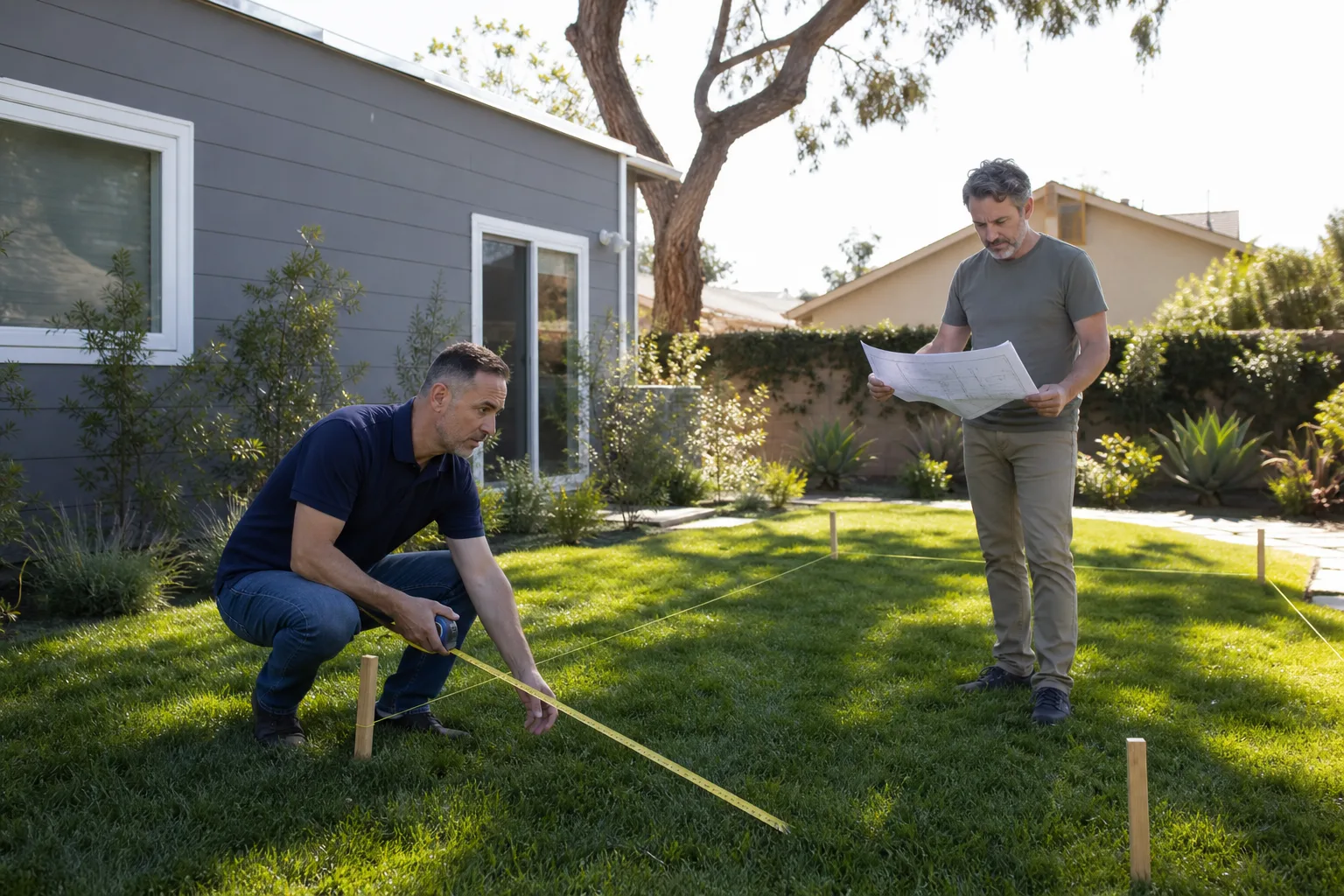
- Pre-submittal meeting (if required): Detached ADUs over 800 square feet and SB 9 splits. Bring a rough site plan. The planner will flag sewer lateral design, fire sprinkler triggers, and utility easements.
- Plans and documentation: Full architectural drawings, a site plan showing property lines and the proposed ADU footprint with 4-foot setbacks marked, structural calculations, Title 24 energy compliance documentation, and a completed ADU supplemental intake form.
- Application submittal: Filed through Fresno’s online permit portal. The city will issue a plan-check intake number. This is when the 60-day clock starts, but only if the application is deemed complete.
- Plan check review: A building plan checker and possibly a fire department reviewer (for sprinklered units) review your drawings. First-round comments typically take 3 to 5 weeks in Fresno.
- Plan check corrections and re-submittal: You respond to comments, revise drawings, and re-submit. Each round takes 2 to 4 weeks. Most Fresno ADU permits go through 2 to 3 rounds. Our team has reduced this to 1 round on most projects by addressing the recurring rejection points in the first submittal.
- Permit issuance: Once plan check is cleared, fees are due. You pay the permit fee, school district fee, and any utility connection fees. The permit is issued electronically.
- Pre-construction meeting (if required): Only for ADUs in floodplain areas or with protected tree conditions.
- Construction and inspections: Foundation, framing, and final at a minimum. More on this below.
The whole cycle, from initial application to permit issuance, runs 8 to 20 weeks for an ADU under 800 square feet. Larger or more complicated projects add time. If you’re working with a contractor who has pulled dozens of ADU permits in Fresno, that experience compresses the cycle because the drawings are already formatted to pass plan check the first time.
We build ADUs across the Fresno area and know exactly which plan check comments come back on nearly every submittal. Our clients get that feedback looped into the drawings before we file. If you’re exploring options, start at our ADU Builders in Fresno page for a breakdown of what to expect.
Fees, Impact Costs, and the Under-750-Square-Foot Exemption
Here is what ADU fees actually look like in Fresno as of 2025, based on our recent permit runs:
- Building permit fee: $1,800 to $4,200 for a standard ADU under 800 square feet, based on valuation.
- Plan check fee: 65% of the building permit fee (standard multiplier in Fresno).
- School district fee: $4.08 per square foot for residential square footage in the Fresno Unified School District boundary, with an exemption for ADUs under 500 square feet depending on district policy. This fluctuates.
- Sewer and water connection fees: $3,000 to $9,000 if the ADU triggers a larger meter or new lateral. Attached ADUs that share the existing lateral often pay only a small capacity fee.
- Electrical and plumbing permit fees: $300 to $900 combined.
- Fire sprinkler trigger: If the primary home has sprinklers, the ADU must too. If not, no sprinklers are required unless the ADU exceeds certain fire-flow limits.
Impact fee exemption: California Government Code Section 65852.2(f) prohibits cities from charging impact fees on any ADU under 750 square feet, and requires proportional fee reductions for larger ADUs. This is automatic in Fresno’s fee schedule for detached ADUs, but we have seen the fee appear on attached-ADU statements when the square-footage field was entered incorrectly. The remedy is to file a written request for a fee adjustment, quoting Section 65852.2(f), and the city corrects it. You should not need a variance, a waiver, or any special favor. It’s a right.
What you will pay, regardless of size, are the building permit, plan check, school district fee, and utility connection fees. Those are not impact fees and are not exempt. Total hard costs for permits and utility hookups on a typical 800-square-foot Fresno ADU: $9,000 to $18,000. On an under-750-square-foot ADU: $4,500 to $9,500. Get the exact line items from the city before you commit to a construction contract.
The Three Required Inspections and What Triggers Extra Ones
Every conforming ADU in Fresno requires a minimum of three city inspections:
- Foundation inspection: Called after excavated footing trenches are formed and rebar is placed, before concrete is poured. The inspector checks footing depth, rebar spacing and clearance, and anchor bolt placement. For slab-on-grade ADUs, this includes the underslab plumbing and vapor barrier.
- Framing inspection: Called after all wall, floor, and roof framing is complete and the rough electrical, plumbing, and mechanical work is in place. The inspector checks structural connections, shear nailing, fire blocking, window and door headers, and energy compliance details. This is the most commonly failed inspection in Fresno because missing shear nailing schedules and un-notched, un-drilled plates get flagged often.
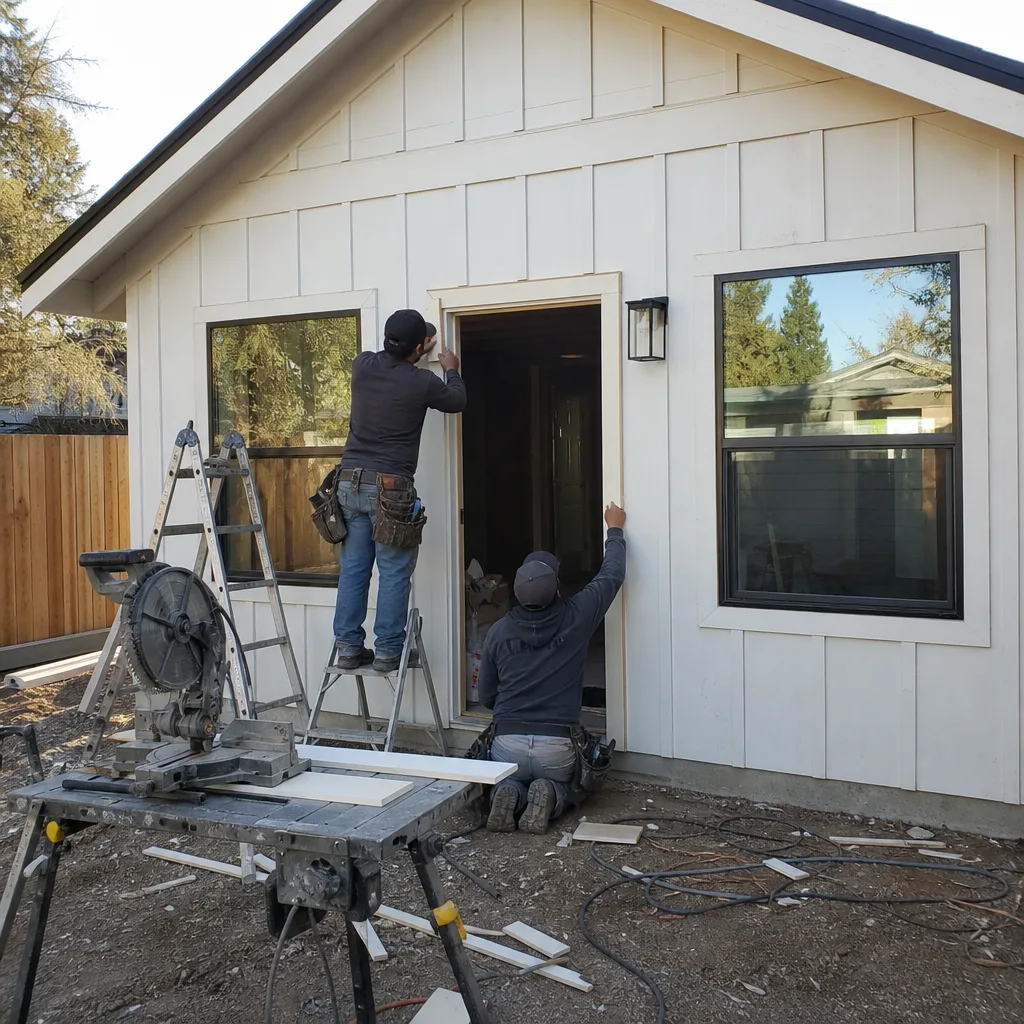
- Final inspection: Called after all finish work, fixtures, appliances, and site improvements are complete. The inspector verifies life-safety items (smoke and CO detectors, egress windows), final electrical panel labeling, water heater strapping, and that all prior corrections were completed.
Additional inspections that may apply:
- Fire department inspection: Required if the ADU has fire sprinklers, is in a high-fire-hazard zone mapped by Fresno Fire, or has a non-standard access path from the street.
- Energy compliance inspection: Fresno enforces California’s 2022 Energy Code (Title 24, Part 6), effective January 2023. A HERS verification is required before final on most ADUs, covering duct leakage, insulation quality, and window performance.
- Sewer lateral inspection: If you’re connecting to a new sewer lateral, Public Works will inspect the connection before the trench is backfilled.
- Encroachment permit inspection: If any driveway, curb cut, or sidewalk work is required, the Public Works inspector adds a separate touchpoint.
Expect 6 to 12 total inspection visits for a typical Fresno ADU. Each requires 24 to 48 hours of notice. Failing an inspection in Fresno costs a re-inspection fee of $118 to $240 and adds 3 to 7 days to your schedule. The contractors who pass the first time are the ones who pre-inspect with their own checklist before calling the city.
Legalizing an Unpermitted ADU in Fresno
Fresno has a lot of converted garages. The pre-1970 housing stock, combined with years of relaxed enforcement, means thousands of properties in the Tower District, Roosevelt, and Sunnyside neighborhoods have unpermitted in-law units that were never inspected. In our experience, roughly one in five homes we assess for an ADU addition also has an unpermitted conversion that needs to be brought into compliance; see ADU Warning Signs: A Fresno Homeowner’s Reference Guide for red flags to watch for.
Here is what retroactive legalization actually looks like:
- Disclosure is not required by the city, but it affects resale. Unpermitted square footage must be disclosed when you sell. Legalized square footage counts toward your home’s assessed value and appraised value.
- You cannot be penalized with back fees for the work done years ago. The city assesses fees based on current code compliance, not on when the work was done.
- You will need to bring the unit up to current building, energy, and egress codes. That often means adding a proper egress window, upgrading electrical to AFCI breakers, installing hardwired smoke and CO detectors, and improving ceiling height or structural clearance if the garage slab is cracked or undermined.
- The legalization permit process is the same as a new ADU permit, but the plan check is a “as-built” review: you document what exists, identify non-compliant items, and correct them. The cost is typically $2,500 to $6,000 in permit fees, plus construction costs for correction work, which may run $8,000 to $25,000 depending on how much of the conversion was substandard.
- A fresh permitted ADU is often faster and cheaper than legalizing a bad conversion. We tell homeowners this straight, because the math sometimes works against retrofitting. If the existing garage slab is too thin, the walls are unbraced, the roof is flat-to-ground, and there’s no insulation, you might rebuild rather than retrofit.
For homeowners weighing a legalization against a fresh build, our Room Addition Contractor in Fresno page covers cost comparisons in more detail.
Prefab ADUs and Permitting: What Changes
Prefab ADUs change the permit dynamic. Products from Dvele, Boxabl, and Plant Prefab arrive with engineered plans, structural calculations, and Title 24 energy documentation already complete. The city has less to review because the structural work is pre-engineered, and the plan check can be shorter.
Here is what changes:
- Factory inspection replaces most framing inspection. Modules bear a California factory certification insignia, so Fresno’s inspector typically checks only the site work (foundation, utilities, final), not the framing inside the module.
- Structural drawings are generic and pre-approved by the state. The city plan check is focused on site-specific work: foundation design, utility connections, grading, and setbacks.
- The site-built portion of a prefab ADU still gets a full foundation and final inspection. That work is done by local crews under local permit.
- Brand-specific constraints apply. A Dvele module is a high-performance panelized home designed for off-grid capability, and its HVAC and electrical systems require specific rough-in layouts. A Boxabl unit is a 20×20-foot foldable module with its own structural logic. You cannot mix and match a Boxabl shell with arbitrary site-built roof trusses. The permit documents must match the manufacturer’s specifications exactly, or the city will reject the submittal.
The prefab route typically saves 4 to 8 weeks on plan check and reduces framing inspection days. The tradeoff is a longer lead time for module fabrication (3 to 6 months for most manufacturers), and the fact that site work, foundation, and utility connections still follow the same Fresno permit sequence as site-built. If you want a hard comparison of prefab versus stick-built for your lot, start with our Home Addition Contractor in Fresno page.
Common Mistakes to Avoid
- Trusting the permit counter’s oral statement over the written code. Fresno’s Development and Resource Management Department is a large organization, and not every staff member has been trained on the latest ADU statutes. If you’re told something that contradicts state law, ask for the citation in writing.
- Assuming the 60-day clock starts at submittal. The clock starts only when the application is deemed “complete.” Incomplete applications can sit in limbo for weeks before the first plan check comment arrives.
- Not invoking the impact fee exemption in writing. The exemption is automatic by law for ADUs under 750 square feet, but attaching a one-paragraph letter citing Section 65852.2(f) to your submittal removes any chance of the fee appearing on the statement.
- Building the ADU before permit issuance. We see this in Fresno more than any other single violation. Homeowners pour a slab thinking they’ll “fix it later with the permit.” The city can then require destructive testing, exposure of work, and fees that erase whatever time was saved.
- Ignoring the sewer lateral capacity question. An ADU adds a bathroom and kitchen, which changes your sewer demand. If your lateral is old clay pipe, it may need replacement. This is not a permit issue until it becomes one, but it can be a $6,000 to $12,000 surprise during construction.
- Skipping the Title 24 energy documentation. Fresno enforces the 2022 Energy Code strictly. Plans without the proper CF-1R compliance form get returned in the first round of plan check.
When to Call a Professional
You can file an ADU permit yourself in Fresno. It is legal, and the city will process a homeowner-builder permit. But the practical question-covered in our DIY vs Professional ADU: The Fresno Homeowner’s Decision Guide-is whether the time and re-submittal cost justify doing it alone. If you have never prepared a set of structural drawings, completed a Title 24 energy report, or responded to a plan check comment letter, expect the process to take 6 to 12 months instead of 2 to 4. A professional team that has pulled dozens of ADU permits in Fresno can also flag site issues before they become plan check rejections: sewer lateral condition, protected trees, utility easement conflicts, and fire sprinkler triggers.
If you’re weighing the cost of hiring a permit consultant or design-build firm, compare that cost against 3 to 6 months of delayed rental income. The math usually favors hiring a professional. Benson ADU Fresno offers free estimates in Fresno, and we walk you through the permit path before you sign anything. Call (559) 206-2363 and ask for a written scope and price.
Frequently Asked Questions
An ADU permit in Fresno typically costs $3,500 to $9,000 in city fees for a unit under 750 square feet, including building permit, plan check, school district fee, and sewer and water connection fees. ADUs under 750 square feet are exempt from impact fees by state law. Call (559) 206-2363 for an exact written estimate for your property.
Plan check for a conforming ADU in Fresno takes 8 to 20 weeks from submittal to permit issuance, assuming the application is complete and drawings are prepared to code. First-round plan check comments typically take 3 to 5 weeks. Call (559) 206-2363 and we’ll give you a realistic timeline for your specific project.
No. California Government Code Section 65852.2 prohibits cities from requiring owner-occupancy as a condition for ADU permits, and Fresno’s municipal code reflects this. If you are told otherwise at the permit counter, ask for the written ordinance citation. Call (559) 206-2363 if you hit resistance and we’ll point you to the right section.
An ADU in Fresno requires fire sprinklers if the primary home has them, or if the ADU is in a mapped high-fire-hazard zone or has a non-standard access path flagged by the Fresno Fire Department. Most standard Fresno ADUs on conforming lots do not require sprinklers. Call (559) 206-2363 for a site-specific assessment.
Yes. Fresno processes unpermitted garage conversions through the same permit path as new ADUs, using an as-built plan check. The city does not penalize you for past work, but you must bring the unit to current code, including egress windows, electrical upgrades, and smoke and CO detection. Call (559) 206-2363 and we’ll assess your existing conversion for free.
Yes. A prefab ADU from Dvele, Boxabl, or Plant Prefab still requires a Fresno building permit for the site work, foundation, and utility connections. The difference is that the factory-certified module skips the city’s framing inspection, which can save weeks. Call (559) 206-2363 to compare prefab and site-built permit paths for your lot.
The Bottom Line
California ADU law is on your side. The state has stripped away owner-occupancy requirements, parking mandates, and fee structures that used to make ADUs impractical. Fresno’s local process is a ministerial review with a 60-day clock, three core inspections, and a clear fee schedule. The risks are not in the law; they’re in incomplete applications, out-of-date information from well-meaning staff, and construction decisions made before the permit is secured. Know the code, get your fee exemptions in writing, and have your drawings prepared by someone who understands what Fresno plan checkers actually flag. For more guides & resources, visit our blog. That’s the difference between an ADU that gets built and one that gets stuck.
Ready to start? We’re Benson ADU Fresno, and we’ve been building ADUs and additions across Fresno since 2006. Every project comes with a written price before any work starts, and a 365-day guarantee in writing. Call (559) 206-2363 for a free estimate and a straight answer about your property.
Written by Troy Eastman, Owner at Benson ADU Fresno, serving Fresno since 2006.