Last updated October 15, 2026
ADU Warning Signs: A Fresno Homeowner’s Reference Guide
Here’s a statistic that should stop you cold: the most common ADU complaint filed with California’s Contractors State License Board isn’t shoddy framing or a leaky roof. It’s a contractor who took a deposit and then stalled for four months because they were overcommitted on other jobs. Fresno homeowners lose more money to inaction than to bad workmanship. Our How to Hire a ADU Contractor in Fresno: A Step-by-Step Guide covers the vetting process in depth; this article walks you through the warning signs that appear before you sign anything, the red flags that show up mid-project, and the steps you can take if something already feels wrong. You’ll learn what separates a legitimate Fresno ADU contractor from one who’s about to make your life difficult, and you’ll get the exact tools to protect your deposit, your timeline, and your property.
Quick Answer
ADU warning signs in Fresno fall into three categories: bid documents that lack line-item detail, contractor behavior that avoids written commitments, and mid-construction shortcuts that bypass permits and inspections. A legitimate Fresno ADU contractor will provide a written price with a permit line and engineering line before work starts, pull permits themselves, and never push for cash payments. If you see a suspiciously round bid number, a reluctance to put things in writing, or an “informal” inspection arrangement, stop and get a second opinion before spending another dollar.
Table of Contents
- Red Flags Hiding in the Bid Document
- Contractor Behavior to Watch Before You Sign
- Site and Structural Warning Signs Mid-Construction
- Prefab and Modular Delivery Red Flags
- What to Do When You Spot a Warning Sign Mid-Project
- Fresno-Specific Risk Factors Most National Guides Ignore
- A 7-Step Vetting Process Before You Hire Any ADU Contractor
- Common Mistakes to Avoid
- When to Call a Professional
- Frequently Asked Questions
- The Bottom Line
Red Flags Hiding in the Bid Document
The bid document is where most Fresno ADU disasters announce themselves. A written proposal tells you how a contractor thinks about money, transparency, and accountability. When you know what a complete bid looks like, an incomplete one becomes obvious fast.
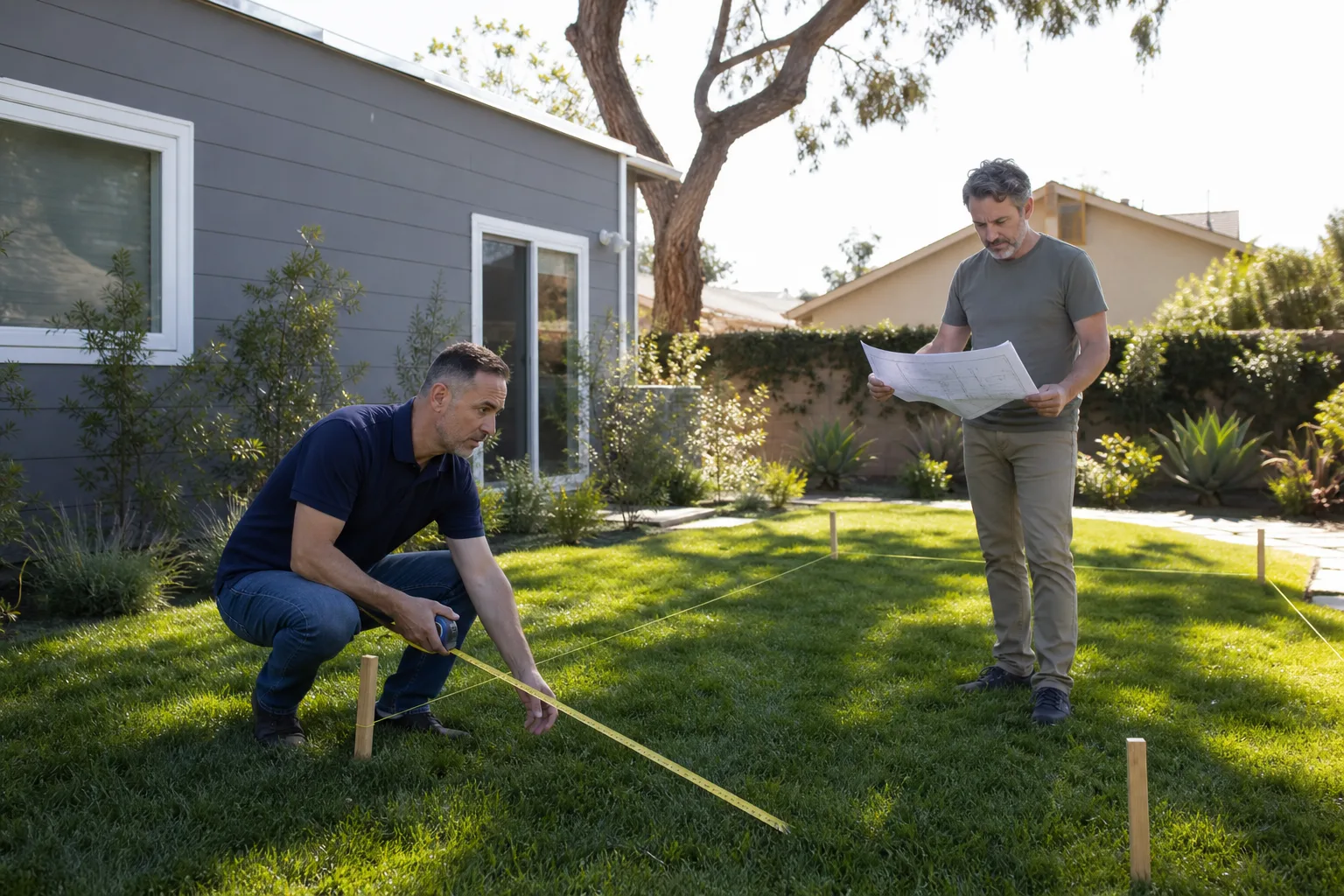
A legitimate ADU bid in Fresno typically runs 8 to 15 pages. It includes architectural drawing references, a scope-of-work narrative, a line-item cost breakdown, a permit fee estimate, an engineering cost line, a materials allowance schedule, and a payment schedule tied to milestones. When a contractor hands you a one-page number scribbled on a letterhead, that’s not a bid. That’s a guess with an invoice attached.
The four specific red flags we tell every Fresno homeowner to check for:
- No line-item breakdown. If the entire project is summarized as “ADU construction: $187,000” with no framing, electrical, plumbing, drywall, or finish lines, you have no way to verify what you’re actually paying for. A real bid breaks down at least fifteen to twenty categories. Without that breakdown, change orders become a blank check for the contractor.
- No permit cost line. ADU permits in California cost real money. Fresno’s permitting fees vary by project scope but routinely run into the thousands. If the bid doesn’t list a permit line, either the contractor forgot it (which is its own red flag) or plans to hit you with it later as a “surprise” cost. Either way, you want it in writing upfront.
- No engineering cost line. Every ADU needs structural engineering: foundation design, shear wall calculations, roof load analysis. That work isn’t free, and it’s not optional. A bid without an engineering line usually means the contractor hasn’t thought through the structural realities of your specific lot, or they plan to have an engineer “look at it” later at your expense.
- A suspiciously round total number. Real construction bids are precise. They end in numbers like $173,420 or $204,815 because they’re the sum of hundred of line items. When a bid comes in at exactly $180,000 or $200,000, that’s a contractor who picked a number out of the air and reverse-engineered the work to match. Precision signals preparation. Round numbers signal improvisation.
For reference, most Fresno homeowners should expect a site-built ADU to land somewhere between $180 and $350 per square foot depending on site conditions, finish level, and whether you choose a prefab option. Prefab ADUs from brands like Abodu, Cover, or Dvele often start in the $150,000 to $250,000 range for a standard one-bedroom unit, delivered and set, before you factor in site work, permits, and utilities. We’ll talk more about prefab-specific red flags later in this guide.
One more thing about the bid: check whether the payment schedule is tied to completed milestones or to calendar dates. A milestone schedule says “25% upon foundation completion, 25% upon framing inspection passed, 25% upon drywall, 25% upon final inspection.” A calendar schedule says “25% on the 1st, 25% on the 15th” regardless of what’s actually been built. Milestone schedules protect you. Calendar schedules protect the contractor.
Contractor Behavior to Watch Before You Sign
The way a contractor behaves during the bidding process is a preview of how they’ll behave during construction. In our experience working with Fresno homeowners, the personality red flags are more predictive than anything in the paperwork.
Pressure to skip the written contract. Every legitimate ADU project in Fresno has a written contract. Every single one. If a contractor says “we don’t really need all that paperwork” or “my word is my bond,” what they’re actually saying is “I don’t want a document you can hold me to.” Walk away. A verbal agreement for a $200,000 project is not trust. It’s exposure.
Reluctance to pull permits themselves. In California, the contractor is legally required to pull permits for construction work they perform. If a contractor suggests you pull the permit as an “owner-builder” to save money, they’re asking you to assume legal liability for the project while they continue to profit from the work. This is a common tactic with unlicensed or under-licensed operators in the Fresno market. It also frequently voids home insurance coverage if something goes wrong. A licensed contractor who is confident in their work pulls the permit in their own name, passes inspections, and closes the permit. No exceptions.
Insistence on cash payment milestones. Cash payments are how contractors avoid taxes, avoid creating a paper trail, and avoid accountability. If a contractor asks for cash, or offers a “discount” for cash, consider that a deal-breaker. Pay by check, ACH transfer, or credit card, and demand a written receipt for every payment. If the contractor can’t produce a receipt, they can’t produce accountability. Fresno’s ADU market has enough reputable builders that you never need to accept a cash arrangement.
The disappearing act during bidding. A contractor who takes two weeks to return your bid, who doesn’t answer emails, or who reschedules your site walk three times is showing you exactly how they’ll operate once you’ve paid a deposit. If communication is hard before they have your money, it won’t improve after.
Refusing to share references or past project addresses. A legitimate Fresno ADU contractor can point you to completed projects. They can give you addresses of ADUs they’ve built, or put you in touch with past clients. If every project is “confidential” or the references never seem to be available, there’s a reason. Drive by the project addresses they provide. Look at the work from the street. If the contractor won’t give you addresses, that’s your answer.
One behavioral green flag worth noting: a contractor who encourages you to research the brands they build with. When we discuss prefab options with Fresno homeowners, we point them to our DIY vs Professional ADU: The Fresno Homeowner’s Decision Guide and tell them to look up Abodu, Cover, and Dvele independently. Those brands publish their own specs, warranties, and pricing. A contractor confident in their product selection wants you informed. A contractor who wants you in the dark is hiding something.
Site and Structural Warning Signs Mid-Construction
Once shovels are in the ground, a different set of warning signs appears. These are the ones that require you to pay attention between progress photos and milestone payments. The sooner you catch them, the less expensive they are to fix.
Framing that doesn’t match the approved plan. Your approved plans are a legal document. They specify exact dimensions, exact window placements, exact structural members. If you walk the site and see a window where the plan shows a wall, or ceiling joists spaced wider than specified, that’s not a “minor variation.” That’s a structural and code problem. Ask the contractor to explain the discrepancy in writing. If the explanation doesn’t match the plan, call the city. Fresno’s building inspectors will catch discrepancies at the framing inspection, but that’s the last moment to correct them cheaply. After drywall goes up, every fix is expensive.
Inspections being “handled informally.” There is no informal inspection process in Fresno. Inspections are scheduled through the city, performed by city inspectors, and logged in the city’s permit system. If a contractor says an inspection was “handled” without a city inspector on site, if they say the inspector “just signed off over the phone,” or if they discourage you from being present at inspections, that’s a serious red flag. You have the right to attend every inspection. You should. The inspection record is your proof that the work is legal.
Subcontractors who don’t know who the GC is. Walk the site and ask the framers, the electricians, the plumbers who the general contractor is. They should know. If they shrug, or give a name that doesn’t match the company you hired, there’s a good chance the project is being run by someone without the proper license or oversight. On a well-run Fresno ADU site, every sub knows the GC, knows the project manager, and knows how to reach both. Confusion about the chain of command is a warning sign about the chain of command.
Materials that look different from what was specified. Your contract should specify brand names and model numbers for major components: windows, roofing, siding, insulation, appliances. If you see different brands on site than what’s in the contract, bring it up immediately. Substitution without written approval is a classic cost-cutting move. A contractor who substitutes materials without asking will also substitute labor quality without asking.
Change orders that appear without warning. Change orders happen on every project. Soil conditions shift. Rot is discovered. Utilities are further away than the plot plan suggested. But legitimate change orders come with written explanations, cost breakdowns, and your signature before work proceeds. If work is already done and then a bill appears, that’s not a change order. That’s an ambush. The written contract should specify exactly how change orders work, including the approval process and payment terms.
Prefab and Modular Delivery Red Flags
Prefab ADUs are a growing share of the Fresno market because they offer factory-controlled quality, compressed timelines, and fixed pricing from manufacturers like Abodu, Cover, and Dvele. But prefab has its own set of warning signs that site-built projects don’t face, and homeowners need to know what to verify before a module leaves the factory floor.
No factory inspection report. A quality prefab manufacturer will provide a factory inspection report documenting that the module was built to plan, passed quality control checks, and was inspected by a third-party certifier before shipment. If your contractor can’t produce that report, ask why. It’s the prefab equivalent of a framing inspection, and it should exist for every unit. Without it, you’re accepting a product that hasn’t been verified by anyone except the people who built it.
Vague delivery windows. Prefab delivery requires crane scheduling, street permits, and coordination with the factory’s shipping calendar. A professional contractor will give you a delivery window measured in days, not months, and will update you as the date approaches. If the delivery date keeps slipping, if the contractor says “the factory is backed up” without providing documentation, or if you can’t get a straight answer about when the module actually leaves the factory, that’s a sign of poor project management. The factory will know, to the week, when your unit ships. If your contractor doesn’t, they’re not talking to the factory.
No written warranty from the manufacturer. This is the big one. When you buy a prefab ADU from a brand like Abodu or Dvele, the manufacturer provides a written warranty on the structure and major systems. That warranty is separate from whatever your contractor verbally promises. If your contractor can’t show you a manufacturer warranty document, or says “don’t worry, I’ll take care of any issues,” you’re relying on a verbal promise instead of a legal document. Get the warranty in writing. Confirm its duration, confirm what it covers, confirm who to call if the manufacturer goes out of business and the contractor has to stand behind the work.
Mismatch between the factory spec sheet and the contractor’s description. Ask for the manufacturer’s spec sheet and compare it to what the contractor told you. Do the dimensions match? Does the finish level match? Does the energy performance match? Contractors sometimes describe a base model and quote an upgraded price, or describe an upgraded model and deliver a base unit. The spec sheet is the source of truth. If the contractor won’t share it, that’s all the information you need.
One clarification worth making: prefab ADUs still require site work, and site work is where most prefab cost overruns happen. Foundation prep, utility connections, grading, and permitting are all site responsibilities. A good Fresno prefab contractor will clearly separate factory costs from site costs in the bid, and will explain exactly what’s included in the factory price and what’s excluded. If those lines blur, ask for them to be redrawn before you sign.
What to Do When You Spot a Warning Sign Mid-Project
You’ve found a problem. Framing doesn’t match the plans. The contractor wants cash. The inspection was “handled informally.” Here’s the step-by-step process for protecting yourself, your deposit, and your property.
- Document everything in writing. Take photos. Keep every text message, email, and voice mail. Summarize verbal conversations in a follow-up email (“Confirming our conversation today, you said the framing will be corrected before the next inspection”). Written records are your evidence if the situation escalates. A calendar of when things happened is powerful. A photo album of the site with dates is powerful. Your memory is not.
- Review your written contract. The contract should specify how disputes are handled, how change orders work, and what happens if either party stops performing. Read those clauses carefully. They define your rights and your obligations. If you don’t understand them, get a second opinion before taking action.
- Talk to the contractor directly. Give them a chance to explain and correct the issue. Some problems are genuine miscommunications. A professional contractor will want to fix whatever’s wrong and keep the project moving. Send the concerns in writing, ask for a written response, and set a deadline. If the response is defensive, evasive, or doesn’t address the specific issues you raised, that tells you a lot.
- File a complaint with the CSLB. The California Contractors State License Board has a formal complaint process. You can file online. You’ll need your contractor’s license number (which should be on your contract), a description of the issue, and your documentation. The CSLB investigates complaints about license violations, contractor misconduct, and substandard work. This process doesn’t move quickly, but it creates a formal record and can result in disciplinary action against the contractor’s license. Filing does not cost you anything.
- Consider a stop-work notice. If the situation is serious enough that continuing the work would make things worse, you have the right to stop the project. Put the stop-work request in writing, state the specific reasons, and reference the contract provisions that support your position. Then stop making payments. Don’t withhold payment without a documented reason tied to contract non-performance, because that can put you in breach as well. But if the contractor has materially failed to perform, you are not obligated to keep funding the failure.
- Get an independent inspection. If you suspect the work doesn’t meet code, hire an independent inspector or a licensed structural engineer to review the site. They’ll document deficiencies in a written report that you can use in any dispute or CSLB proceeding. This costs money, but it’s the best evidence you can produce if the problem escalates.
- Talk to a construction attorney if needed. For disputes over substantial money, a construction attorney can review your contract, advise you on your options, and write the letters that get a contractor’s attention. This is the nuclear option, but it exists for a reason. California construction law has specific rules about liens, stop notices, and contractor bonding. An attorney can help you navigate those.
Here’s the pattern across all seven steps: written records, contract references, and professional third parties. If your contractor is uncomfortable with any of those three elements, that discomfort is itself diagnostic. A legitimate contractor welcomes documentation because it protects them as much as it protects you. This is also where we, as a team of ADU builders in Fresno, see the biggest difference between projects that recover and projects that collapse: the homeowners who kept written records from day one could always prove their position.
Fresno-Specific Risk Factors Most National Guides Ignore
National ADU guides talk about setbacks and FAR calculations, but they miss the things that actually matter on the ground in Fresno. Here are the local factors that create unique risk and unique opportunity.
Summer heat and construction timing. Fresno routinely hits 100 degrees from June through September. That heat affects concrete curing, adhesive bonding, and worker productivity. A contractor who schedules foundation pours for mid-July at 2 p.m. is either inexperienced or indifferent. Proper Fresno construction schedules pour concrete in the early morning, use curing compounds suited to high heat, and adjust work hours to protect both materials and workers. If your contractor’s schedule doesn’t account for heat, that’s a warning sign about their local experience. A contractor with experience in the Central Valley knows this instinctively.
Expansive clay soil on the east side. Much of Fresno sits on expansive clay that swells when wet and shrinks when dry. That movement cracks foundations, shifts slabs, and damages structures built without proper soil preparation. If your bid doesn’t include a soils report or a foundation design that accounts for expansive soils, ask why. This is standard practice for Fresno ADU construction, and a contractor who skips it is betting your foundation against the valley’s geology. The soils report is usually a few thousand dollars, and it’s worth every penny.
Setback and lot coverage rules vary by neighborhood. Fresno’s zoning code doesn’t treat every neighborhood the same. Older neighborhoods like the Tower District have different lot dimensions and setback patterns than newer subdivisions in northwest Fresno or the Sunnyside area. A national ADU guide can’t tell you your specific setbacks. A Fresno contractor should know them from your address within the first conversation. If a contractor gives you a generic answer about setbacks (“they’re usually about four feet”), that’s a sign they haven’t checked the actual zoning for your parcel.
Alley access and utility runs. Many older Fresno homes have alley access, which affects where utility connections go and how prefab modules get delivered. If your ADU site requires running sewer lines 60 feet across the lot to an alley main, that’s a significant cost that should be in the bid. A contractor who doesn’t ask about your utility connection points during the bidding process hasn’t thought through the project. Ask specifically: where does the sewer connect? Where does the electrical service come from? How are these costs reflected in the bid?
Permit processing realities. Fresno’s permit processing times fluctuate with staffing and workload. A contractor who promises a permit in “a couple weeks” is overpromising. A realistic Fresno ADU permit timeline is measured in months, not weeks, and depends on whether your project requires design review, zoning variances, or utility upgrades. Ask your contractor when they last pulled a Fresno ADU permit, how long it took, and what the current backlog looks like. If they can’t answer those questions confidently, they’re not working in Fresno regularly.
We’ve worked on Fresno ADU projects across enough neighborhoods to know that the difference between a smooth build and a nightmare usually comes down to local knowledge. A contractor who has built ten ADUs in Fresno has already made and learned from mistakes a newcomer will make on your project. You can learn more about how we approach these projects on our Benson ADU Fresno home page, but the key point is this: ask your contractor about Fresno-specific conditions and see if the answers are specific or generic.
A 7-Step Vetting Process Before You Hire Any ADU Contractor
Here is the full vetting sequence we recommend to every Fresno homeowner evaluating ADU contractors. Run through it in order, and you’ll eliminate most problem contractors before they ever touch your property.
- Verify the license. Go to the CSLB website and look up the contractor’s license number. Confirm it’s active, confirm it’s held by the person or company you’re actually talking to, and check for any disciplinary actions or complaints. This takes five minutes. Never skip it. California requires any contractor performing work over $500 to hold a valid license, and ADU construction absolutely qualifies.
- Verify insurance. Ask for a certificate of insurance naming you as an additional insured. Confirm it includes general liability and workers’ compensation coverage. Call the insurance company to verify the policy is active. Contractors sometimes provide certificates for policies they’ve already let lapse. The call takes ten minutes and protects you from liability if a worker is injured on your property.
- Ask for three recent ADU references. Not “past clients.” Not “happy customers.” Specifically: three clients who had ADU projects completed in the last 24 months. Call them. Ask about communication, change orders, final cost versus bid, and whether they’d hire the contractor again. A contractor who can’t produce three recent ADU references hasn’t built three recent ADUs.
- Visit a completed project in person. Ask for the address of a completed ADU and drive by. You can’t go inside without the owner’s permission, but you can see the exterior work, the rooflines, the finish quality, the landscaping restoration. If the contractor won’t give you an address, that’s the answer.
- Request a written bid with line items. You already know what to look for. No line items, no permit line, no engineering line, round numbers: all red flags. A complete written bid is the single most important document in the hiring process. If you’re comparing multiple bids, compare them line by line, not total to total. A lower total with no permit line is not a lower price. It’s a delayed invoice.
- Ask about the project manager by name. Find out who will actually be running your project day to day. Get a name, get a phone number, and ask how often that person will be on site. A contractor who runs six projects simultaneously with one project manager is asking for scheduling chaos. If the answer is vague, push until it’s specific.
- Request a written schedule with milestones. The schedule should map out site prep, foundation, framing, rough-in, drywall, finish work, and final inspection. Each milestone should have a date range. The payment schedule should align with the construction milestones. If the contractor won’t commit to a written schedule, they won’t commit to a timeline, and you’ll be the one waiting by the phone for four months like the homeowners in those CSLB complaints.
This process takes a few hours spread over a couple of weeks. For a project that will cost you $150,000 to $300,000 and affect your property for decades, that’s the highest-return time investment you’ll make all year. For more guides & resources on vetting contractors, see our blog; it’s also worth noting that there is no correlation between the size of a contractor’s marketing budget and the quality of their ADU work. The most advertised name in Fresno is not necessarily the best builder. The vetting process reveals what advertising hides.
Common Mistakes to Avoid
- Hiring the lowest bid without comparing line items. A bid that’s $40,000 lower than the others almost always means something is missing: permits, engineering, site work, or realistic contingency. You’ll pay that $40,000 later, usually with stress and delay attached. Compare bids line by line, not total to total.
- Paying a large deposit before permits are in hand. California law limits down payments for home improvement contracts to 10% of the project cost or $1,000, whichever is less. Anything beyond that is a violation. Report violations to the CSLB. Don’t write a $50,000 check before the permit is pulled and verified.
- Skipping the soils report to save $3,000. Fresno’s expansive clay doesn’t care about your budget. A foundation designed without soil data is a foundation gambling against geology. The cost of a soils report is trivial compared to the cost of foundation repair.
- Accepting verbal promises as contractual terms. “We’ll fix that later.” “The warranty is five years, trust me.” “Don’t worry about the permit, we’ll handle it.” None of these statements exist unless they’re in the contract. If it’s not written, it didn’t happen. Insist that every promise appears in the written contract before you sign.
- Not attending inspections. Fresno requires specific inspections at specific construction points. You have the right to be there. Showing up is free, and it’s the only way to see with your own eyes whether the work was actually reviewed. A homeowner who attends every inspection sends a message that this project is being watched.
- Paying the final invoice before final inspection passes. The final payment should only be made after the final inspection passes, the permit is closed, and you’ve received all warranties and close-out documents. If the contractor wants final payment before final inspection, that’s a red flag that the inspection might not pass.
- Ignoring your instincts. If a contractor seems evasive, defensive, or too busy for your questions during the bidding phase, that’s not going to improve once they have your money. Fresno has enough qualified ADU contractors that you never need to ignore a gut feeling. The contractor you hire should make you feel more informed, not more confused.
When to Call a Professional
Some situations call for a second opinion from a licensed professional. If you’ve spotted any of the warning signs described in this guide, if your bid document feels incomplete, if your contractor is pressuring you to skip permits or pay in cash, or if construction has stopped without explanation, it’s time to get professional eyes on the situation. A qualified Fresno home addition contractor can review your bid, walk your site, and tell you honestly whether your project is on track or off the rails. If you’re considering an alternative to a site-built project, a room addition contractor familiar with Fresno’s code requirements can also help you evaluate whether that approach fits your lot and budget better. Benson ADU Fresno offers free estimates in Fresno. Call (559) 206-2363 and we’ll walk your project with you, review any bid you already have, and give you a written assessment with no obligation.
Frequently Asked Questions
Site-built ADUs in Fresno typically run $180 to $350 per square foot, which puts most one-bedroom units between $150,000 and $250,000 all-in before finishes. Prefab ADUs from brands like Abodu or Dvele often start around $150,000 to $200,000 for the factory-built unit, with additional site work costs for foundation, utilities, and permits. The exact number depends on your lot conditions, finish selections, and whether you choose site-built or prefab construction. Get a written line-item bid to understand exactly where your money goes. Call (559) 206-2363 for a free Fresno ADU estimate with a full cost breakdown.
The most common Fresno ADU contractor problems are deposit stalls, permit avoidance, and cash payment requests. Deposit stalls happen when a contractor takes your down payment and then prioritizes other jobs for months. Permit avoidance happens when a contractor asks you to pull permits as an owner-builder so they can avoid license scrutiny. Cash requests eliminate the paper trail you’d need to file a complaint with the CSLB. A legitimate contractor does none of these things. If you’re seeing any of these behaviors, stop and get a second opinion before making another payment.
A complete ADU bid includes a line-item cost breakdown covering at least fifteen categories, a permit fee estimate, an engineering cost line, a materials allowance schedule, a scope-of-work narrative, and a milestone-based payment schedule. It also references the architectural drawings and site plan that the pricing is based on. If your bid is one page with a single number, it’s incomplete. Ask for the full version before you sign anything.
Visit the California Contractors State License Board website and search by license number or business name. Confirm the license is active, held by the person or entity you’re actually contracting with, and free of disciplinary actions. Also verify insurance coverage by asking for a certificate of insurance and calling the insurer to confirm the policy is current. This takes about fifteen minutes total, and it’s the most basic due diligence any homeowner should perform before hiring.
Yes. You can issue a stop-work notice in writing, citing specific contract violations or substandard work. You should also review your contract’s termination clause, document everything in writing, and file a complaint with the CSLB if the contractor has violated licensing rules. Withholding payment is appropriate when the contractor has materially failed to perform. Consult a construction attorney if the dispute involves substantial amounts before taking irreversible steps.
Prefab ADUs reduce some risks and introduce others. The factory controlled process from brands like Abodu, Cover, and Dvele eliminates weather delays and framing inconsistency, and the manufacturer warranty provides accountability that site-built projects often lack. But prefab still requires site work, foundation prep, utility connections, and permits, and those elements carry the same contractor risk as any construction project. The key is to demand a factory inspection report, a written manufacturer warranty, and clear separation between factory costs and site costs in your bid. Prefab isn’t automatically safer. It’s safer only when the contractor is transparent.
The Bottom Line
The warning signs that derail Fresno ADU projects are visible before the permit is pulled, if you know what to look for. Incomplete bids, permit avoidance, cash requests, and vague communication are not personality quirks. They’re predictive indicators of how the next twelve months will go. Run the seven-step vetting process. Demand line items. Attend every inspection. Get every promise in writing. If you’re evaluating a contractor right now and something feels off, it probably is. Benson ADU Fresno offers free estimates and written line-item bids with no obligation. Call (559) 206-2363 and we’ll give you a straight answer about your project, even if that answer is that we’re not the right fit. The book on Fresno ADUs is written in the documents before the first shovel turns. Read yours carefully.
Written by Troy Eastman, Owner at Benson ADU Fresno, serving Fresno since 2006.